
Much like Tutankhamen in Egypt, the Lord of Sipan was a mummy discovered with immense quantities of precious metals and stones in his tomb. Sipán, in the Lambayeque valley in Peru, is famed for its rich tombs revealed by archaeologists. The Lord of Sipan’s tomb – discovered in 1987 – is also known as ‘Huaca Rajada’ and its tomb and artifacts – since stored in the impressive Royal Tombs Museum – are a highlight of the Moche Route in northern Peru.
The Lord of Sipan
The burial platform served as a mausoleum for a succession of Moche lords, accompanied to the afterlife by a stunning selection of burial offerings. The pieces that the lord was buried with are of exquisite quality, with intricately designed earrings, masks, necklaces, bracelets and all sorts of ornaments crafted of gold, silver, copper and semi-precious stones. These take on beautiful forms representing animals, spiders and ghostly faces.
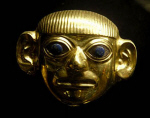
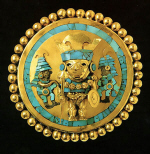
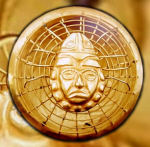
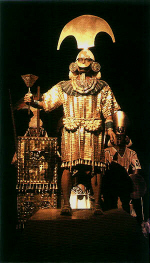
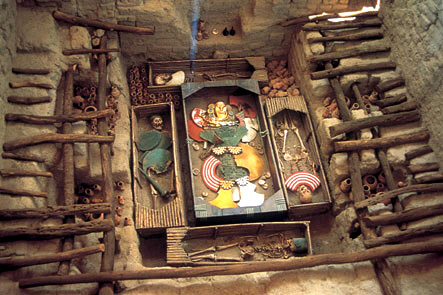
All photos are sourced here, all pieces are property of the Museo Tumbas Reales in Lambayeque.
The Moche Culture
Due to the high quality of burial items, it is believed that the Lord of Sipan – or Señor de Sipán – was an important ruler of the Moche culture around 250AD. The Moche culture was one of the most important cultures in northern Peru, and they inhabited the coastal region from around 100AD-700AD, a millennia before the Incas.
Discovering the tomb of the Lord of Sipan
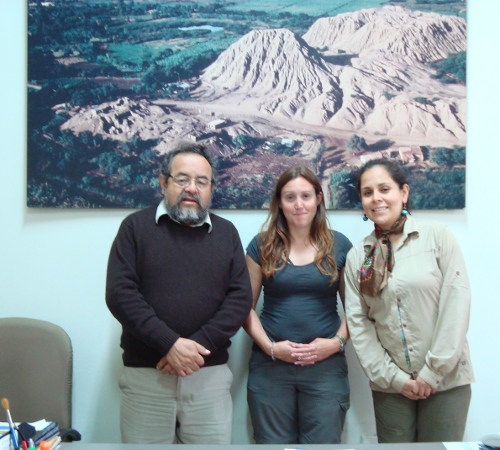
The tomb of the Lord was discovered in 1987 by a team led by the archaeologist Walter Alva. In a recent visit to northern Peru, Cristina of Aracari met Walter in person. She was most impressed with his work and his passion for Archaeology and how Walter has helped his discoveries and others like it to foster economic development in the region.
The tomb of the Lord of Sipán is the most archaeologically engaging of the Moche burial sites – indeed, it is considered by some archaeologists to be the most important intact tomb found in the American Continent.
The Sipán discovery, along with Huaca de la Luna and Cao Viejo, provides clues to a Moche rite known as the Sacrifice Ceremony, an elaborate blood-letting ritual illustrated on ceramics and in murals embellishing the walls of Moche temples.
Visit the Moche Route, including the Lord of Sipan, with our 4D/3N Highlights of Northern Peru itinerary
Royal Tombs Museum
The pieces found with the Lord of Sipan are now housed in a contemporary museum in northern Peru in the Tumbas Reales Museo de Sipan in the town of Lambayeque. This opened in 2002 with the support of Walter Alva and is becoming a Peru travel hotspot.
Visiting the Moche Route
There are a number of fascinating archeological sites along northern Peru’s archaeological circuit, known as the Moche Route.
Contact us today for a tailormade trip Peru, including the highlights of Peru’s northern coast.