
The Incan Khipu Record Keeping System
People living in pre-Columbian Peru did not need to use writing because they had developed other sophisticated means of keeping records, storing data and recounting stories based on textiles and cords. By the time of the Inca Empire, a device called the Khipu (also known as Quipu) had developed, a system of using knotted and coloured strings to record information. These Khipus would be carried by Inca messengers across the Empire to transmit messages and deliver important communications.
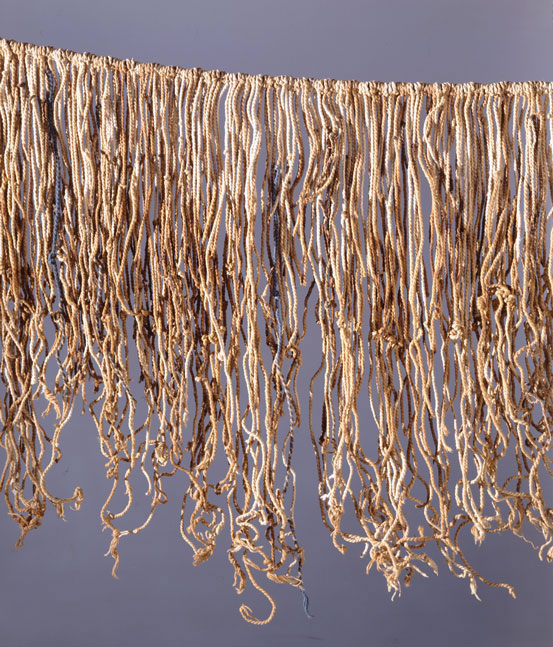
Picture of a Khipu from the Khipu Database Project website
Talking Knots
The Khipu functioned in a manner whereby such details as the positioning of a knot on a cord, the number of revolutions of thread on a cord, the shade of colour of a cord and so forth would represent different numbers, words, ideas and sometimes even whole concepts. In conjunction with this, there was a strong oratory tradition in which stories and legends would be passed down from generation to generation by word of mouth, often assisted by a Khipu.
Reading a Khipu
Unfortunately today, it is not known exactly how to “read” Khipus. During the conquest of the Incas the Spanish burned many Kuipus dismissing them as primitive, heretic and against the bible and the word of god; there are only around 600 that survive to this day. The Spanish found it perplexing that such a device could hold detailed information. The last person to have been able to interpret Kuipus is thought to have died only relatively recently, in the 1930’s, and tragically nobody thought it worthwhile to learn their skill!
Academic Studies of Khipus
Gary Urton of Harvard University has enacted detailed studies into interpreting the few Khipus that remain. Such studies reveal that there might be a tremendous amount of information held within Khipus, everything from Inca Empire census data and bookkeeping to astronomical data and interpretations of the cosmos. To find out more, visit the comprehensive Khipu Database Project website.
