
The Question:
Did Inca royalty really marry their sisters?
The Answer:
The short answer is, yes, it is true that in late times of the Inca Empire, Inca royalty did marry their sisters. The long answer and the reasoning for this incest is very much disputed and, even more so, interesting.
To begin with a little context: according to latter succession rules of the Inca lineage, when the Inca died, the succeeding Inca had to be the son of the Coya, or Queen, of the deceased Inca. The Coya was the first wife of the Inca, the woman whom married during his succession to the Inca throne.
Originally the incumbent Inca was determined simply by the Inca choosing the most able amongst all of his sons, or, when the father had not chosen which son should succeed him before his death, by a specially designated council.
The problem with this system was that it invited a violent scramble for the prized throne between the potentially many sons of the Inca conceived with his oft numerous wives, mistresses and concubines. All of the Inca’s sons had equal rights to the throne, and they sometimes bitterly disputed who would succeed to the extent that even bloody assassination of rivals was not overlooked. As such, the decision was made that only the sons of the Coya should be able to succeed the Inca throne, to avoid such bickering.
Now, the practice of the Inca marrying his own sister as Coya appears to have arisen as a way of even further strengthening the claim that the sons of that Inca and his Coya would have to succeed their father after his death. If an Inca were to conceive with his own sister this would vastly reduce the chances of squabbling after the death of the Inca, as the claim to the throne would be much stronger for those sons who had two parents with royal blood.
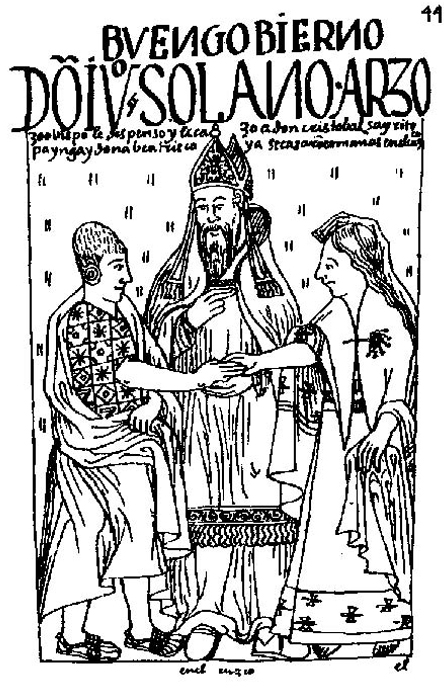
An Inca royal wedding between brother and sister, drawing by Guaman Poma de Ayala
Thus, incestuous marriages of the Inca lineage were borne out of political factors, to stabilise a very weak and ambiguous system of succession in an attempt to avoid civil war and dangerous political disunity in an ever larger and more fragmented Empire. Despite this intention, the tactic had limited success and rivalries between even the sons of the sister Coya still ran rife, but that’s another story…
To read even more into this fascinating and complicated subject check out the works listed below. The second article can be accessed from the UCA Berkeley by clicking here.
Bibliography.
· María Rostworowski de Diez Canseco and John V. Murra, “Succession, Coöption to Kingship, and Royal Incest among the Inca” in Southwestern Journal of Anthropology, Vol. 16, No. 4, p. 417-427 (University of New Mexico, Winter, 1960)
· John Rowe , “Inca Culture at the Time of the Spanish Conquest” in Handbook of South American Indians, Julian H. Steward (Ed.) , Vol. 2, p. 183-330 (Washington Smithsonian Institution, 1946)