Did the Incas have the wheel? Although the Incas were very advanced and did in fact know about the concept of the wheel, they never developed it in practice. This was quite simply because their empire spanned the world’s second highest mountain range, where there were more straightforward methods to carry goods than using the inca wheel.
The Inca Wheel
In it’s heyday – right at the time of the Spanish Conquest in the 1530’s – the Inca Empire stretched all the way from northern Argentina to Southern Colombia, an area defined chiefly by high peaks, narrow valleys and barren rocky terrain. Carrying goods was thus far more convenient by porters and on pack animals, such as llamas, who were well attuned to traversing tricky mountain slopes with heavy loads…. far easier than dragging a wagon up a mountain I’m sure you’ll agree!
The Ina Road Network
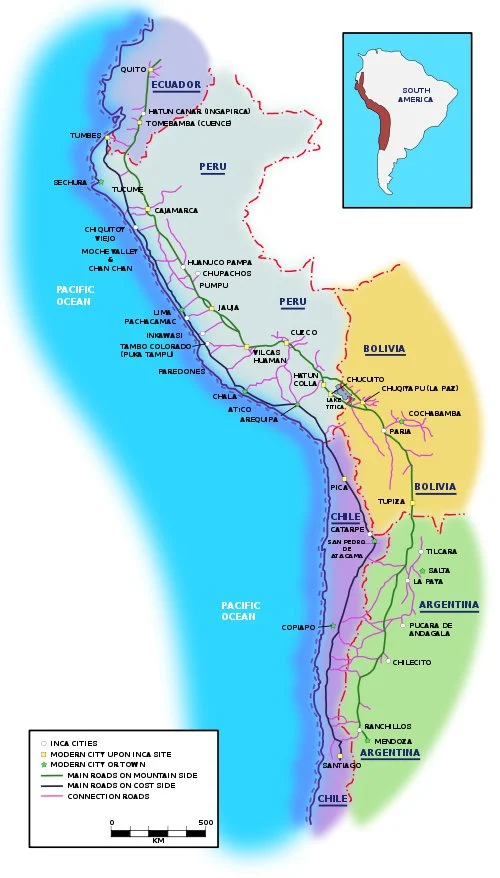
In order to make travel by foot easier, the Incas developed an extensive and complex system of roads for transportation and communications, which they called Khapaq Ñan. This covered the vast majority of their Empire, the total length of road incorporated is thought to have been around 25,000 miles, the same as the Earth’s diameter. The most famous stretch of road is, of course, The Inca Trail to Machu Picchu.
Exploring Peru on Foot
At Aracari, as locally-based specialists in luxury travel Peru, we encourage you to try out the time-honoured tradition of navigating the Andes by foot and take advantage of the many incredible Peru treks available, from day hikes, to multi-day lodge-to-lodge treks, to the famous Inca trail to Machu Picchu.
Map of the Inca Road System
This fantastic map of the Inca road system comes from Wikipedia: